Evaluation of the Energy Storage Capacity of Cocoa Lignocellulosic Material
Evaluación de la Capacidad de Almacenamiento de Energía del Material Lignocelulósico de Cacao

How to Cite
Download Citation



Show authors biography
Similar Articles
- Morayma Muñoz, Napoleón Padilla, Grace Morrillo, Marco Rosero, Electrocoagulation as a Sustainable Alternative for the Treatment of Refinery Effluents: Application in Esmeraldas Refinery , Revista Técnica "energía": Vol. 22 No. 1 (2025): Revista Técnica "energía", Edición No. 22, ISSUE I
- Mónica Romero, Diego Chacón, Josselin Salinas, Leslie Culcay, Electrical Model of a Piezoelectric System for Generating Energy Through the Force Applied in a Step , Revista Técnica "energía": Vol. 22 No. 2 (2026): Revista Técnica "energía", Edición No. 22 ISSUE II
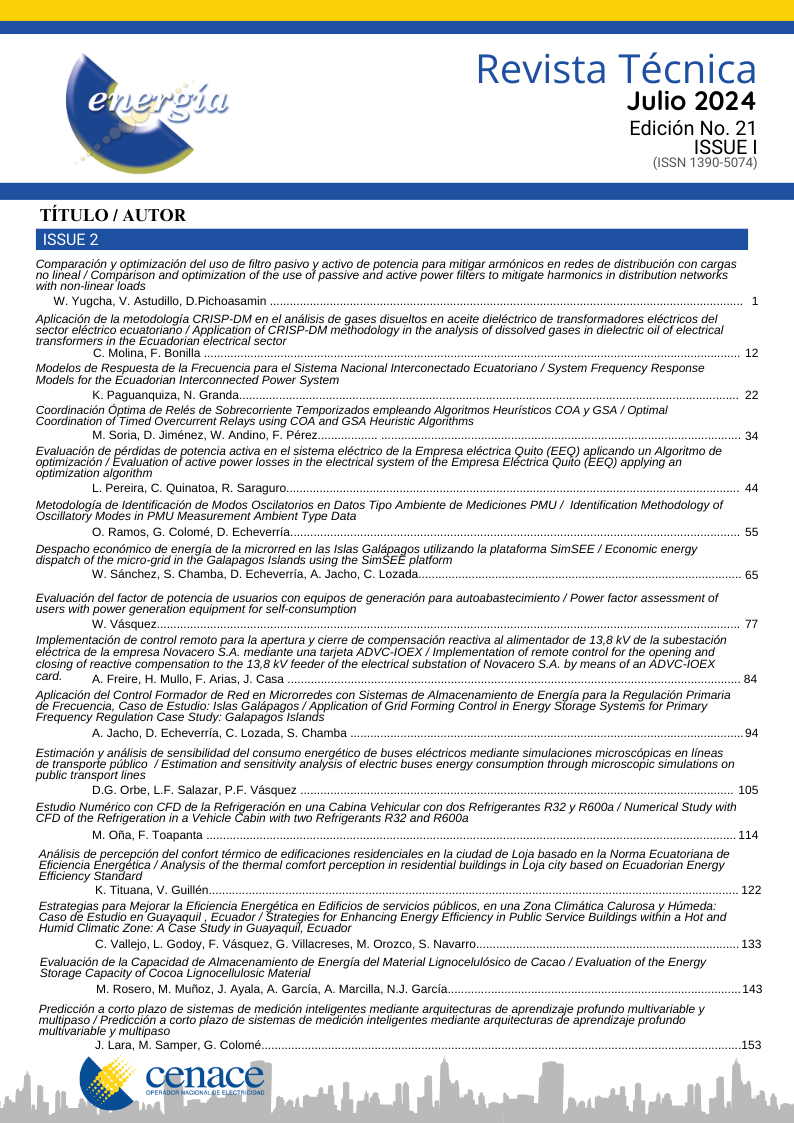
- Andrés Pereira, Roberth Saraguro, Carlos Quinatoa, Evaluation of Active Power Losses in the Electrical System of the Empresa Eléctrica Quito (EEQ) Applying an Optimization Algorithm , Revista Técnica "energía": Vol. 21 No. 1 (2024): Revista Técnica "energía", Edición No. 21, ISSUE I
- Nilo Robles, Daniel Rivadeneira, Michelle Herrera, Wilmer Ponce, Analysis of the Temporal and Geographical Influence of Sampling on the Physicochemical Properties of FORSU in Manabí, Ecuador. , Revista Técnica "energía": Vol. 22 No. 2 (2026): Revista Técnica "energía", Edición No. 22 ISSUE II
- Wilson Brito, Wilson Sánchez, Performance Evaluation of LSTM and XGBoost Models for Electric Demand Forecasting in the Ecuadorian Power System , Revista Técnica "energía": Vol. 22 No. 2 (2026): Revista Técnica "energía", Edición No. 22 ISSUE II
- José Castro, Paúl Soto, Ruth Reategui, Tuesman Castillo, Partitioning of an Electrical Distribution Systems Using K-Means and DBSCAN Clustering Algorithms , Revista Técnica "energía": Vol. 20 No. 1 (2023): Revista Técnica "energía", Edición No. 20, ISSUE I
- Joffre Constante, Augusto Riofrío, Aharon De La Torre, Jaime Cepeda, Methodology for Steady-State and Dynamic Modelling of S.N.I in HYPERsim, Application in the Electromagnetic Transient Analysis for 500 kV Systems , Revista Técnica "energía": Vol. 16 No. 2 (2020): Revista Técnica "energía", Edición No. 16
- Jhon Calle, Wilian Guamán, Fernanda Velasco, Edgar Cajas, ATPDraw-Based Methodology for the Pre-Configuration and Experimental Validation of Lightning Impulse Tests in Power Transformers. , Revista Técnica "energía": Vol. 23 No. 1 (2026): Revista Técnica "energía", Edición No. 23 ISSUE I
- Edison Novoa, Gabriel Salazar Yépez, Eliana Buitrón, Gabriel Salazar Pérez, Methodological Proposal for Targeting Electric Subsidy "Tarifa De La Dignidad" in Residential Users of the Electric Companies of Ecuador , Revista Técnica "energía": Vol. 20 No. 1 (2023): Revista Técnica "energía", Edición No. 20, ISSUE I
- Armando Freire, Fernando Arias, Héctor Mullo, Jhonny Casa, Implementation of Remote Control for the Opening and Closing of Reactive Compensation to the 13,8 kV Feeder of the Electrical Substation of Novacero S.A. by means of an ADVC-IOEX Card , Revista Técnica "energía": Vol. 21 No. 1 (2024): Revista Técnica "energía", Edición No. 21, ISSUE I
You may also start an advanced similarity search for this article.
Most read articles by the same author(s)
- Morayma Muñoz, Napoleón Padilla, Grace Morrillo, Marco Rosero, Electrocoagulation as a Sustainable Alternative for the Treatment of Refinery Effluents: Application in Esmeraldas Refinery , Revista Técnica "energía": Vol. 22 No. 1 (2025): Revista Técnica "energía", Edición No. 22, ISSUE I





The purpose of this study is to determine the energy storage capacity of the material obtained from cocoa husks in a capacitor configuration. The lignocellulosic material comes from Ecuadorian cocoa harvests used in agro-industrial processes. Analysis of the volatiles generated during instant pyrolysis was conducted using GC/MS technique. Additionally, a comparison of the capacitor with two different electrolytes was made: sulfuric acid (H2SO4) and sodium chloride (NaCl). The material processing involved carbonization and chemical activation processes, carried out in a pyrolysis reactor under an inert nitrogen (N2) atmosphere at a heating rate of 20 °C min-1, and activated at 850 °C in the same atmosphere for 4 hours. Electrodes were prepared from this material and tested using cyclic voltammetry to assess energy storage at different scan rates for five cycles. The results of the GC/MS analysis and cyclic voltammetry demonstrated that the prepared secondary raw material can be used to obtain high-value added products. The main identified volatile compounds include phenols, acetic acid, and alcohols. The maximum potential was 1,1 kW kg-1 with NaCl electrolyte, and the maximum durability was achieved with H2SO4 electrolyte with a power of 0,29 kW kg-1; these values were obtained at a scan rate of 100 mV s-1.
Article visits 1727 | PDF visits 488
Downloads
- A. Avadí, “Environmental assessment of the Ecuadorian cocoa value chain with statistics-based LCA,” Int J Life Cycle Assess, vol. 28, no. 11, pp. 1495–1515, Nov. 2023, doi: 10.1007/s11367-023-02142-4.
- Ministerio de Agricultura y Ganadería, “Informe Macroeconómico Agropecuario,” INEN. Accessed: Mar. 10, 2024. [Online]. Available: http://sipa.agricultura.gob.ec/index.php/cifras-agroproductivas.
- Gerencia de Estudios Cambiarios BCE, La Actividad Petrolera en Ecuador en la Década de los 80. Quito: Banco Central del Ecuador, 1990.
- Instituto Nacional de Preinversión, Atlas bioenergético de la República del Ecuador. Quito: Esin Consultora S.A., 2014.
- H. Hosseinzadeh-Bandbafha and M. Kiehbadroudinezhad, “Environmental Impacts of Chocolate Production and Consumption,” in Trends in Sustainable Chocolate Production, Cham: Springer International Publishing, 2022, pp. 229–258. doi: 10.1007/978-3-030-90169-1_7.
- G. A. Enrríquez, Curso sobre el cultivo de cacao. Turrialba: CATIE, 1985.
- International Cocoa Organization, “ICCO,” https://www.icco.org/.
- INEC, “Encuesta de Superficie y Producción Agropecuaria Continua,” 2022. Accessed: Mar. 24, 2024. [Online]. Available: https://www.ecuadorencifras.gob.ec/documentos/web-inec/Estadisticas_agropecuarias/espac/espac_2022/PPT_%20ESPAC_%202022_04.pdf
- N. Müller, C. Tessini, C. Segura, and A. Berg, “Pirólisis rápida de biomasa,” Chile, 2013. [Online]. Available: https://www.researchgate.net/publication/309733974
- M. Kumar, S. N. Upadhyay, and P. K. Mishra, “Pyrolysis of Sugarcane (Saccharum officinarum L.) Leaves and Characterization of Products,” ACS Omega, vol. 7, no. 32, pp. 28052–28064, Aug. 2022, doi: 10.1021/acsomega.2c02076.
- N. Acosta, J. De Vrieze, V. Sandoval, D. Sinche, I. Wierinck, and K. Rabaey, “Cocoa residues as viable biomass for renewable energy production through anaerobic digestion,” Bioresour Technol, vol. 265, pp. 568–572, Oct. 2018, doi: 10.1016/j.biortech.2018.05.100.
- M. V. Vidal, A. Rodríguez, K. Martínez, J. Ocampo, and W. Barrios, “Potencial de residuos agroindustriales para la síntesis de Carbón Activado: una revisión,” Scientia Et Technica, Pereira, pp. 412–420, Aug. 27, 2018.
- Y. Yetri et al., “Synthesis of activated carbon monolith derived from cocoa pods for supercapacitor electrodes application,” Energy Sources, Part A: Recovery, Utilization, and Environmental Effects, pp. 1–15, Aug. 2020, doi: 10.1080/15567036.2020.1811433.
- L. D. Ramírez-Valencia, F. E. López-Suárez, L. R. Conde, Esther. Bailón-García, A. Bueno-López, and A. F. Perez-Cadenas, “Cocoa husk as precursor of carbonaceous materials for supercapacitors electrodes,” Journal of Electroanalytical Chemistry, vol. 963, p. 118325, Jun. 2024, doi: 10.1016/j.jelechem.2024.118325.
- A. M. García et al., “Monolithic mesoporous graphitic composites as super capacitors: from Starbons to Starenes®,” J Mater Chem A Mater, vol. 6, no. 3, pp. 1119–1127, 2018, doi: 10.1039/C7TA09338A.
- G. Diossa, C. D. Castro, Z. Zapata-Benabithe, and G. Quintana, “Evaluación de la capacidad de almacenamiento de energía en xerogeles de carbono activados obtenidos a partir de lignina,” 2017, doi: 10.18273/revion.v30n2-2017002.
- C. Diaz Arriaga, D. E. Pacheco Catalán, J. M. Bass López, and J. Uribe Calderón, “Capacitor electroquímico basado en PPy-(SO4)2−: efecto del dióxido de manganeso como templete reactivo en las propiedades electroquímicas,” Mar. 2021.
- M. J. Mostazo-López, R. Ruiz-Rosas, E. Morallón, and D. Cazorla-Amorós, “Nitrogen doped superporous carbon prepared by a mild method. Enhancement of supercapacitor performance,” Int J Hydrogen Energy, vol. 41, no. 43, pp. 19691–19701, Nov. 2016, doi: 10.1016/j.ijhydene.2016.03.091.
- Y. Yetri, Mursida, D. Dahlan, Muldarisnur, E. Taer, and Febrielviyenti, “Analysis of Characteristics of Activated Carbon from Cacao (Theobroma cacao) Skin Waste for Supercapasitor Electrodes,” in IOP Conference Series: Materials Science and Engineering, IOP Publishing Ltd, Dec. 2020. doi: 10.1088/1757-899X/990/1/012023.
- F. Ahmad, W. M. A. W. Daud, M. A. Ahmad, and R. Radzi, “Cocoa (Theobroma cacao) shell-based activated carbon by CO 2 activation in removing of Cationic dye from aqueous solution: Kinetics and equilibrium studies,” Chemical Engineering Research and Design, vol. 90, no. 10, pp. 1480–1490, Oct. 2012, doi: 10.1016/j.cherd.2012.01.017.
Biannual: Publications in January and July

Ebsco

Google Académico

Scielo

Doaj

Oaji

Latindex

Researchbib
Miar

DOI

Crossref

Europub

I2or

Redib