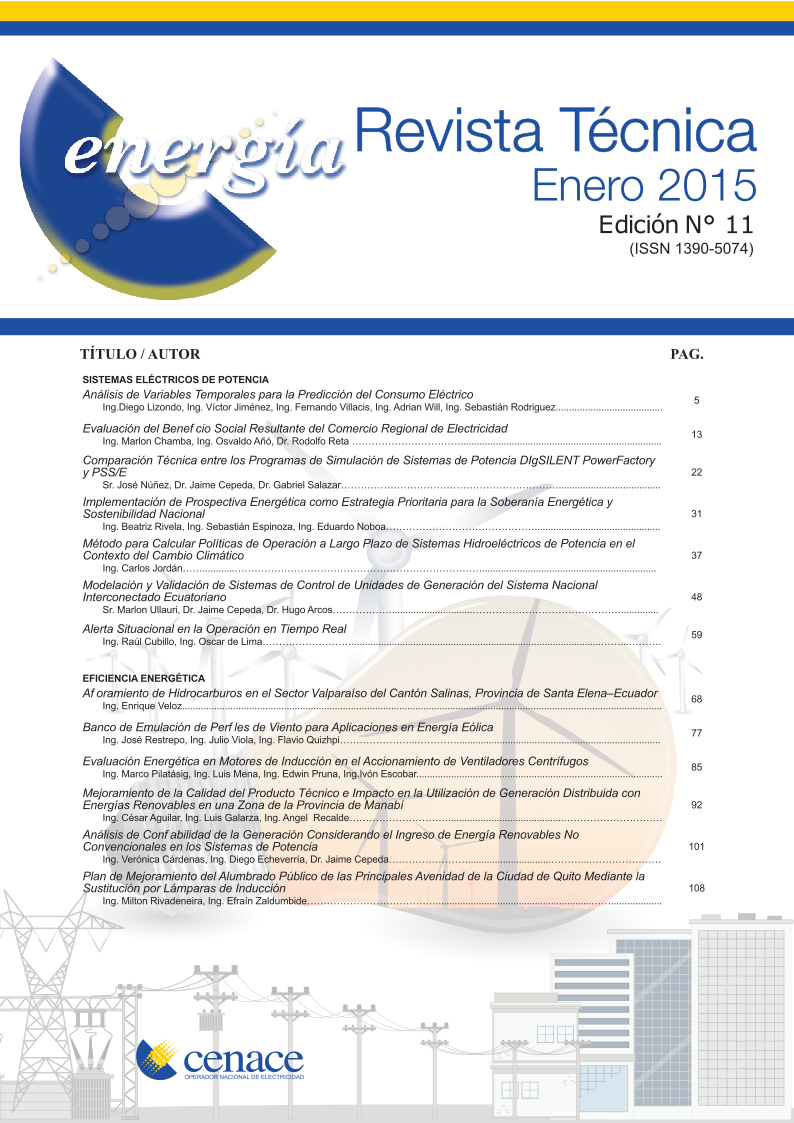
Implementación de Prospectiva Energética como Estrategia Prioritaria para la Soberanía Energética y Sostenibilidad Nacional
Implementación de Prospectiva Energética como Estrategia Prioritaria para la Soberanía Energética y Sostenibilidad Nacional

How to Cite
Download Citation



Show authors biography
Similar Articles
- Wilson Sánchez, Diego Echeverría, Santiago Chamba, Andrés Jacho, Carlos Lozada, Economic Energy Dispatch of the Micro-Grid in the Galapagos Islands Using the Simsee Platform , Revista Técnica "energía": Vol. 21 No. 1 (2024): Revista Técnica "energía", Edición No. 21, ISSUE I
- Gabriela Araujo, Andrés Robalino, Energy Subsidies and Urban Consumption in Ecuador: Distortions and Pathways for Transition , Revista Técnica "energía": Vol. 22 No. 2 (2026): Revista Técnica "energía", Edición No. 22 ISSUE II
- Paulo Castro, Jaime Cepeda, Impact Analysis of Non-Dispatchable Renewable Energies Penetration in Power System Operational Security , Revista Técnica "energía": Vol. 22 No. 1 (2025): Revista Técnica "energía", Edición No. 22, ISSUE I
- Carlos Lozada, David Panchi, Wilson Sánchez, Andrés Jacho, Linear Regression for the Identification of the Maximum Power Point in Hybrid Microgrids Implemented in HYPERSIM , Revista Técnica "energía": Vol. 20 No. 2 (2024): Revista Técnica "energía", Edición No. 20, ISSUE II
- Diego Lojano, Juan Palacios, Optimal Power Flow in Electrical Power Systems with Environmental Considerations , Revista Técnica "energía": Vol. 21 No. 2 (2025): Revista Técnica "energía", Edición No. 21, ISSUE II
- Julio Lascano, Luis Chiza, Roberth Saraguro, Carlos Quinatoa, Jessy Tapia, Demand Estimation for an Electric Vehicles Charging Station Through the Application of Probabilistic Methods , Revista Técnica "energía": Vol. 20 No. 1 (2023): Revista Técnica "energía", Edición No. 20, ISSUE I
- Julio Cardenas, Graciela Colomé, Estefania Tapia, Adaptive Generator Tripping to Improve Transient Stability in Systems with Renewable Generation Integration , Revista Técnica "energía": Vol. 22 No. 2 (2026): Revista Técnica "energía", Edición No. 22 ISSUE II
- Joffre Constante, Lesly Ochoa, Brayan Caiza, Walter Rueda, Omar Chuquitarco, Parametric Identification of the Oscillatory Component Load Model Using Synchrophasor Measurements and Optimization Techniques , Revista Técnica "energía": Vol. 22 No. 2 (2026): Revista Técnica "energía", Edición No. 22 ISSUE II
- Daniels Mendoza, Isai Nina, Edwin Cuadros, Analysis of a Geothermal Pilot Plant with a Medium-Enthalpy Binary Cycle, Ubinas, Moquegua , Revista Técnica "energía": Vol. 21 No. 2 (2025): Revista Técnica "energía", Edición No. 21, ISSUE II
- Joffre Constante, Henry Laica, Kevin Tituaña, Jessica Castillo, Filtering and Smoothing Techniques Assessment at the ZIP Load Model Parametric Estimation with Ambient PMU Data , Revista Técnica "energía": Vol. 22 No. 2 (2026): Revista Técnica "energía", Edición No. 22 ISSUE II
You may also start an advanced similarity search for this article.





The aim of the present article is to highlight the importance of implementing prospective analysis methods in the Ecuadorian energy sector planning system, in order to generate information that will be used as an input for decision making towards the investment necessary for achieving energy sovereignty and sustainability in the context of the energy and industry matrix transition process. Energy balance and energy forecasting are the main pillars for energy planning given that both constitute tools that generate information and knowledge used for policy formulation and decision making. The undergoing processes in Ecuador of changing the energy, and the industry matrix demand a thoroughly analysis whose results assure the achievement of the objectives set by the Ecuadorian Government in the fields of energy and sufficiency and renewability. INER has proposed the development of a project whose main objective is to establish an interinstitutional panel for integrated management of energy information, and to evaluate and implement methodologies for developing multicriteria energy forecasting scenarios. This will provide inputs for long range energy planning, and policy and decision making. One of the key aspects of the project is the consolidation of technical and scientific capabilities on an interinstitutional level to develop energy forecasting. The results of the project are expected to be a key stone for strengthening political and strategic mechanisms that will guarantee energy security and sustainability. This will incise in the change of the energy and industry matrix, and poverty eradication.
Article visits 2001 | PDF visits 533
Downloads
Biannual: Publications in January and July

Ebsco

Google Académico

Scielo

Doaj

Oaji

Latindex

Researchbib

Miar

DOI

Crossref

Europub

I2or

Redib