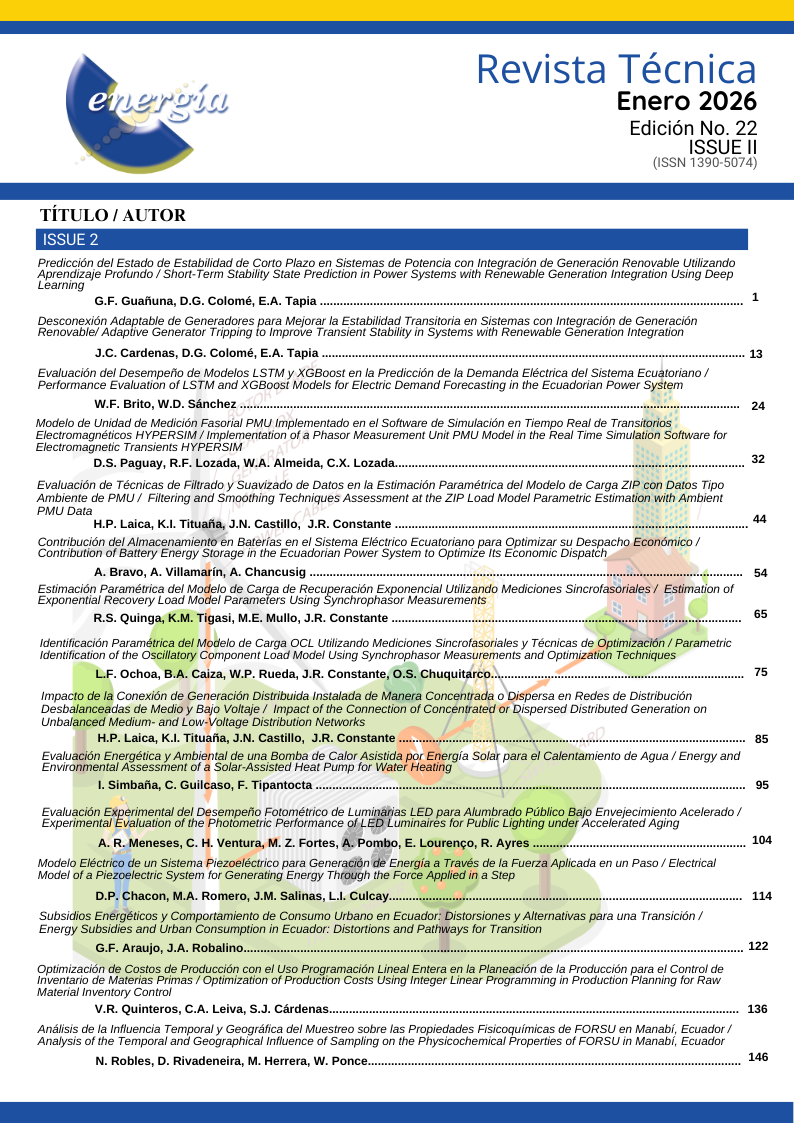
Energy Subsidies and Urban Consumption in Ecuador: Distortions and Pathways for Transition
Subsidios energéticos y comportamiento de consumo urbano en Ecuador: distorsiones y alternativas para una transición

How to Cite
Download Citation



Show authors biography
Similar Articles
- Daniel Orbe, Luis Salazar, Paúl Vásquez, Estimation and Sensitivity Analysis of Electric Buses Energy Consumption through Microscopic Simulations on Public Transport Lines , Revista Técnica "energía": Vol. 21 No. 1 (2024): Revista Técnica "energía", Edición No. 21, ISSUE I
- Edison Novoa, Gabriel Salazar Yépez, Eliana Buitrón, Gabriel Salazar Pérez, Methodological Proposal for Targeting Electric Subsidy "Tarifa De La Dignidad" in Residential Users of the Electric Companies of Ecuador , Revista Técnica "energía": Vol. 20 No. 1 (2023): Revista Técnica "energía", Edición No. 20, ISSUE I
- Morayma Muñoz, Napoleón Padilla, Grace Morrillo, Marco Rosero, Electrocoagulation as a Sustainable Alternative for the Treatment of Refinery Effluents: Application in Esmeraldas Refinery , Revista Técnica "energía": Vol. 22 No. 1 (2025): Revista Técnica "energía", Edición No. 22, ISSUE I
- Alex Villamarín, Angie Bravo, Ariel Chancusig, Contribution of Battery Energy Storage in the Ecuadorian Power System to Optimize Its Economic Dispatch , Revista Técnica "energía": Vol. 22 No. 2 (2026): Revista Técnica "energía", Edición No. 22 ISSUE II
- Wilson Sánchez, Diego Echeverría, Santiago Chamba, Andrés Jacho, Carlos Lozada, Economic Energy Dispatch of the Micro-Grid in the Galapagos Islands Using the Simsee Platform , Revista Técnica "energía": Vol. 21 No. 1 (2024): Revista Técnica "energía", Edición No. 21, ISSUE I
- Wilson Brito, Wilson Sánchez, Performance Evaluation of LSTM and XGBoost Models for Electric Demand Forecasting in the Ecuadorian Power System , Revista Técnica "energía": Vol. 22 No. 2 (2026): Revista Técnica "energía", Edición No. 22 ISSUE II
- Alex Villamarín Jácome, Miguel Saltos, Juan Echever, Optimal Sizing of Photovoltaic and Battery Energy Systems in Residential Environments to Reduce Dependence on Centralized Electricity Infrastructure , Revista Técnica "energía": Vol. 21 No. 2 (2025): Revista Técnica "energía", Edición No. 21, ISSUE II
- Alex Mullo, José Reinoso, Marlon Chamba, Carlos Lozada, Analysis and Characterization of Power Quality using Data Mining , Revista Técnica "energía": Vol. 22 No. 1 (2025): Revista Técnica "energía", Edición No. 22, ISSUE I
- Rolando Noroña, Edgar Cajas, Carlos Lozada, Marlon Chamba, Transient Stability Analysis Using the Concept of Inertia and Data Mining , Revista Técnica "energía": Vol. 22 No. 1 (2025): Revista Técnica "energía", Edición No. 22, ISSUE I
- Fernando Toapanta, Melany Oña, Numerical Study with CFD of the Refrigeration in a Vehicle Cabin with two Refrigerants R32 and R600a , Revista Técnica "energía": Vol. 21 No. 1 (2024): Revista Técnica "energía", Edición No. 21, ISSUE I
You may also start an advanced similarity search for this article.





Since the 1970s, energy subsidies in Ecuador have sought to guarantee universal access, but they have distorted urban consumption by fostering inefficiency, dependence on fossil fuels, and inequality. This study examines how artificially low prices have discouraged clean technologies and hindered energy efficiency, particularly affecting the urban residential sector. Using a bottom‑up approach, tariff sensitivity is evaluated through segmentation models with 16 and 7 variables, applying independence tests to identify significant redistributions. The results reveal structural stability in energy profiles, which supports the proposal of a gradual transition toward more rational pricing, accompanied by targeted policies, eco‑innovation, and compensation for the most vulnerable, as a pathway to a more sustainable, equitable, and fiscally responsible energy matrix.
Article visits 996 | PDF visits 195
Downloads
- [1] S. Espinoza and V. Guayanlema, “Balance y proyecciones del sistema de subsidios energéticos en Ecuador,” *Análisis*, pp. 1–28, 2017. [Online]. Available: http://library.fes.de/pdf-files/bueros/quito/13648.pdf
- [2] R. Jiménez and A. Yépez-García, “Understanding the Drivers of Household Energy Spending: Micro Evidence for Latin America,” *IDB Publ.*, Working Paper, vol. 805, pp. 1–40, 2017. [Online]. Available: https://ideas.repec.org/s/idb/brikps.html
- [3] Ministry of Energy and Mines, “Balance Energético Nacional 2023,” 2023. doi: https://doi.org/10.1016/j.enpol.2017.11.036
- [4] G. Araujo-Vizuete, A. Robalino-López, and Á. Mena-Nieto, “Looking beyond subsidies: Understanding the complexity of household energy consumption dynamics of Ecuador’s main cities,” *Cities*, vol. 163, Apr. 2025. doi: 10.1016/j.cities.2025.106008
- [5] G. Araujo, A. Robalino-López, and J. L. Román, “Propuesta de modelo teórico referente al comportamiento de consumo energético del sector residencial urbano ecuatoriano,” in *Responsabilidad Social y Sostenibilidad: Disrupción e Innovación ante el Cambio de Época*, 2021, pp. 611–634.
- [6] G. Araujo-Vizuete, A. Robalino-López, and Á. Mena-Nieto, “Decoding urban energy use variability: A bottom-up approach in Ecuador,” *Energy*, vol. 327, May 2025. doi: 10.1016/j.energy.2025.136459
- [7] G. Araujo-Vizuete and A. Robalino-López, “Aportes desde el enfoque analítico: Consumo energético del sector residencial del Ecuador,” *Rev. Gestão e Secr.*, vol. 14, no. 4, pp. 6275–6294, 2023. doi: http://doi.org/10.7769/gesec.v14i4.2050
- [8] MEER, “Plan Maestro de Electricidad 2016-2025,” Quito, 2016.
- [9] C. F. Gould, S. B. Schlesinger, E. Molina, M. L. Bejarano, A. Valarezo, and D. W. Jack, “Household fuel mixes in peri-urban and rural Ecuador: Explaining the context of LPG, patterns of continued firewood use, and the challenges of induction cooking,” *Energy Policy*, vol. 136, Sep. 2019, p. 111053, 2020. doi: 10.1016/j.enpol.2019.111053
- [10] M. Villavicencio and M. Ruiz, “Efecto de eliminar subsidio al gas para uso doméstico en el Ecuador,” *RECUS*, vol. 4, no. 3, pp. 29–34, 2019. [Online]. Available: https://dialnet.unirioja.es/descarga/articulo/7368629.pdf
- [11] F. Schaffitzel, M. Jakob, R. Soria, A. Vogt-schilb, and H. Ward, “¿Pueden las transferencias del gobierno hacer que la reforma de los subsidios energéticos sea socialmente aceptable? Un estudio de caso sobre Ecuador,” *Banco Interam. Desarro.*, p. 25, 2019.
- [12] EP Petroecuador, “Informe estadístico. Enero - Diciembre 2021,” 2022. [Online]. Available: https://www.eppetroecuador.ec/wp-content/uploads/downloads/2022/03/INFORME-ESTADISTICO-ENERO-DICIEMBRE-2021.pdf
- [13] World Bank, “International Prices of Petroleum Derivatives: Gasoline and Diesel,” 2016. [Online]. Available: https://data.worldbank.org/indicator/EP.PMP.DESL.CD?locations=EC-CO-PE-1W
- [14] Ministry of Energy and Mines, “El precio de la gasolina súper se regulará de acuerdo a su valor en el mercado,” 2018. [Online]. Available: https://www.recursosyenergia.gob.ec/el-precio-de-la-gasolina-super-se-regulara-de-acuerdo-a-su-valor-en-el-mercado/
- [15] Ministry of Energy and Mines, “El 11 de julio rige nuevo mecanismo de fijación de precios de combustibles,” Jul. 2020. [Online]. Available: https://www.recursosyenergia.gob.ec/el-11-de-julio-rige-nuevo-mecanismo-de-fijacion-de-precios-de-combustibles/
- [16] W. Glad, “Everyday Governance of Domestic Energy Systems,” *Procedia Eng.*, vol. 180, pp. 1612–1621, 2017. doi: 10.1016/j.proeng.2017.04.324
- [17] M. Csutora, A. Zsoka, and G. Harangozo, “The Grounded Survey – An integrative mixed method for scrutinizing household energy behavior,” *Ecol. Econ.*, vol. 182, 2021. doi: 10.1016/j.ecolecon.2020.106907
- [18] N. Iliopoulos, M. Onuki, and M. Esteban, “Shedding light on the factors that influence residential demand response in Japan,” *Energies*, vol. 14, no. 10, pp. 1–23, 2021. doi: 10.3390/en14102795
- [19] G. Shippee, “Energy consumption and conservation psychology: A review and conceptual analysis,” *Environ. Manage.*, vol. 4, no. 4, pp. 297–314, 1980. doi: 10.1007/BF01869423
- [20] G. Araujo-Vizuete and A. Robalino-López, “A Systematic Roadmap for Energy Transition: Bridging Governance and Community Engagement in Ecuador,” *Smart Cities*, vol. 8, no. 80, 2025. doi: https://www.mdpi.com/2624-6511/8/3/80
- [21] FMI, “Energy Subsidy Reform—Lessons and Implications,” 2022. [Online]. Available: https://www.imf.org/en/Topics/climate-change/energy-subsidies
- [22] A. Pelfini, G. Fulquet, and A. Beling, *La energía de los emergentes: innovación y cooperación para la promoción de energías renovables en el Sur Global*. Buenos Aires: Teseo, 2012.
- [23] A. Florini and B. K. Sovacool, “Who governs energy? The challenges facing global energy governance,” *Energy Policy*, vol. 37, no. 12, pp. 5239–5248, 2009. doi: 10.1016/j.enpol.2009.07.039
- [24] B. K. Sovacool, “An international comparison of four polycentric approaches to climate and energy governance,” *Energy Policy*, vol. 39, no. 6, pp. 3832–3844, 2011. doi: 10.1016/j.enpol.2011.04.014
- [25] A. Faiers, M. Cook, and C. Neame, “Towards a contemporary approach for understanding consumer behaviour in the context of domestic energy use,” *Energy Policy*, vol. 35, no. 8, pp. 4381–4390, 2007. doi: 10.1016/j.enpol.2007.01.003
- [26] A. Sohre and I. Schubert, “The how and what of bottom-up governance to change household energy consumption behaviour,” *Energy Res. Soc. Sci.*, vol. 89, Aug. 2021, p. 102570, 2022. doi: 10.1016/j.erss.2022.102570
- [27] V. Međugorac and G. Schuitema, “Why is bottom-up more acceptable than top-down? A study on collective psychological ownership and place-technology fit in the Irish Midlands,” *Energy Res. Soc. Sci.*, vol. 96, Feb. 2023, pp. 1–6. doi: 10.1016/j.erss.2022.102924
Biannual: Publications in January and July

Ebsco

Google Académico

Scielo

Doaj

Oaji

Latindex

Researchbib

Miar

DOI

Crossref

Europub

I2or

Redib