Automatic Voltage Regulator Model Validation Based on Mean-Variance Mapping Optimization and Field Tests
Validación del Modelo de un Regulador Automático de Voltaje basado en Optimización de Mapeo Media-Varianza y Pruebas de Campo

How to Cite
Download Citation



Show authors biography
Similar Articles
- Joffre Constante, Augusto Riofrío, Aharon De La Torre, Jaime Cepeda, Methodology for Steady-State and Dynamic Modelling of S.N.I in HYPERsim, Application in the Electromagnetic Transient Analysis for 500 kV Systems , Revista Técnica "energía": Vol. 16 No. 2 (2020): Revista Técnica "energía", Edición No. 16
- Wilson Brito, Santiago Chamba, Diego Echeverría, Aharon De La Torre, David Panchi, Parameter Identification, Validation and Tunning of Speed Regulator Tool Using Heuristic Optimization Algorithms , Revista Técnica "energía": Vol. 20 No. 2 (2024): Revista Técnica "energía", Edición No. 20, ISSUE II
- Flavio Villacrés, Alexis Torres, Marlon Chamba, Carlos Lozada, Adaptive Load Shedding Strategy for Power Systems Based on Linear Regression , Revista Técnica "energía": Vol. 22 No. 1 (2025): Revista Técnica "energía", Edición No. 22, ISSUE I
- Joffre Constante, Lesly Ochoa, Brayan Caiza, Walter Rueda, Omar Chuquitarco, Parametric Identification of the Oscillatory Component Load Model Using Synchrophasor Measurements and Optimization Techniques , Revista Técnica "energía": Vol. 22 No. 2 (2026): Revista Técnica "energía", Edición No. 22 ISSUE II
- Nelson Granda, Karen Paguanquiza, System Frequency Response Models for the Ecuadorian Interconnected Power System , Revista Técnica "energía": Vol. 21 No. 1 (2024): Revista Técnica "energía", Edición No. 21, ISSUE I
- Carlos Lozada, David Panchi, Wilson Sánchez, Andrés Jacho, Linear Regression for the Identification of the Maximum Power Point in Hybrid Microgrids Implemented in HYPERSIM , Revista Técnica "energía": Vol. 20 No. 2 (2024): Revista Técnica "energía", Edición No. 20, ISSUE II
- Julio Cardenas, Graciela Colomé, Estefania Tapia, Adaptive Generator Tripping to Improve Transient Stability in Systems with Renewable Generation Integration , Revista Técnica "energía": Vol. 22 No. 2 (2026): Revista Técnica "energía", Edición No. 22 ISSUE II
- Joffre Constante, Henry Laica, Kevin Tituaña, Jessica Castillo, Filtering and Smoothing Techniques Assessment at the ZIP Load Model Parametric Estimation with Ambient PMU Data , Revista Técnica "energía": Vol. 22 No. 2 (2026): Revista Técnica "energía", Edición No. 22 ISSUE II
- Andrés Pereira, Roberth Saraguro, Carlos Quinatoa, Evaluation of Active Power Losses in the Electrical System of the Empresa Eléctrica Quito (EEQ) Applying an Optimization Algorithm , Revista Técnica "energía": Vol. 21 No. 1 (2024): Revista Técnica "energía", Edición No. 21, ISSUE I
- Joffre Constante, Robert Quinga, Klever Tigasi, Mauricio Mullo, Estimation of Exponential Recovery Load Model Parameters Using Synchrophasor Measurements , Revista Técnica "energía": Vol. 22 No. 2 (2026): Revista Técnica "energía", Edición No. 22 ISSUE II
You may also start an advanced similarity search for this article.
Most read articles by the same author(s)
- J.C. Cepeda, D. G. Colomé, Evaluación de la Vulnerabilidad del Sistema Eléctrico de Potencia en Tiempo Real usando Tecnología de Medición Sincrofasorial , Revista Técnica "energía": Vol. 10 No. 1 (2014): Revista Técnica "energía", Edición No. 10
- D.E. Echeverría, V.M. Flores, W.M. Villa, J.C. Cepeda, Identificación de Áreas de Control de Voltaje en el Sistema Nacional Interconectado de Ecuador utilizando Minería de Datos , Revista Técnica "energía": Vol. 13 No. 1 (2017): Revista Técnica "energía", Edición No. 13
- P.K. Vásquez, J.C. Cepeda, D.E. Echeverría, V. Ramos, Diagnóstico Situacional para la implementación de un proceso de Gestión de Conocimiento en el Operador Nacional de Electricidad CENACE , Revista Técnica "energía": Vol. 13 No. 1 (2017): Revista Técnica "energía", Edición No. 13
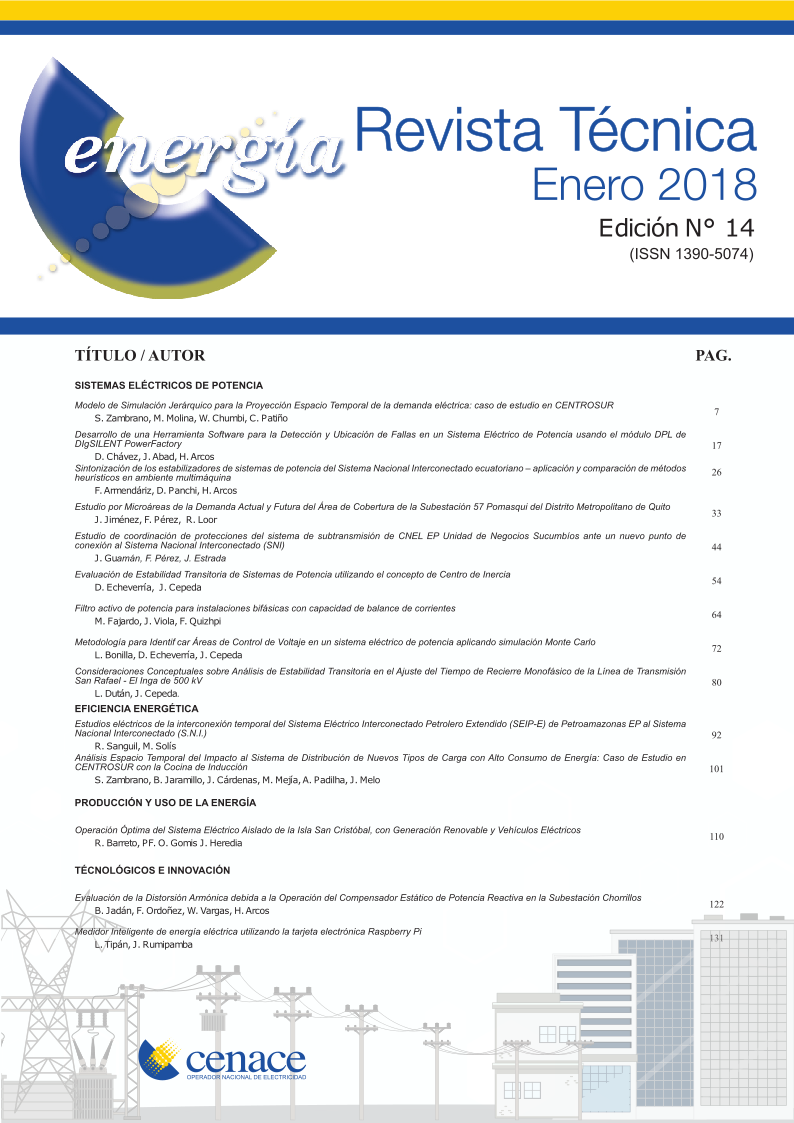
- L.E. Bonilla , D.E. Echeverría , J.C. Cepeda, Methodology to Identify Voltage Control Areas in an Electrical Power System by Applying Monte Carlo Simulation , Revista Técnica "energía": Vol. 14 No. 1 (2018): Revista Técnica "energía", Edición No. 14
- L.M. Dután, J.C. Cepeda, Conceptual Considerations about Transient Stability Assessment for the Adjustment of the Single-Phase Reclosing Time at San Rafael - El Inga 500 kV Transmission Line , Revista Técnica "energía": Vol. 14 No. 1 (2018): Revista Técnica "energía", Edición No. 14
- D.F. Orquera, J.C. Cepeda, P.F. Vásquez , A.B. De la Torre, Methodology based on Synchrophasors for the Identification of Transmission Line Parameters , Revista Técnica "energía": Vol. 14 No. 1 (2018): Revista Técnica "energía", Edición No. 14
- A. De La Torre , J.C. Cepeda, Determinación de Áreas Eléctricas Coherentes por Frecuencia y cómputo de la Frecuencia Promedio del Sistema Nacional Interconectado a partir de Información Sincrofasorial en Tiempo Real , Revista Técnica "energía": Vol. 13 No. 1 (2017): Revista Técnica "energía", Edición No. 13





Power system planning and operation are meaningfully based on a number of analyses which entail steady-state and dynamic simulations. In this regard, modelling the power system with enough detail is a basic requirement mainly for those applications that are based on an accurate prediction of the system dynamic response, such as the design of protective strategies and control schemes. Most models correspond only to a mathematical representation, whose parameters need to be firstly adjusted or identified based on a rational process of model validation which frequently employs experimental data. This paper proposes a parameter estimation method for accomplishing the model validation of power systems through an iterative software-in-the-loop (SIL) simulation, implemented via mean-variance mapping optimization (MVMO) in DIgSILENT PowerFactory, which allows comparing the simulation results with records obtained from field tests. The proposed method is then used to perform the model validation of the automatic voltage regulator (AVR) of Coca Coco Sinclair, Ecuador’s largest hydroelectric power plant. The obtained results are finally compared with two other similar approaches: i) the “Model Parameter Identification” object of PowerFactory, and ii) the “Parameter Estimation” toolbox of MatlabSimulink. Comparisons show the benefits of the proposal to overcome limitations of the other two methods regarding accuracy, constraints and SIL simulation capabilities.
Article visits 1372 | PDF visits 965
Downloads
Biannual: Publications in January and July

Ebsco

Google Académico

Scielo

Doaj

Oaji

Latindex

Researchbib

Miar

DOI

Crossref

Europub

I2or

Redib