Short Term Demand Forecasting methodology for Power Decision Making Based on Markov Chain. Study Case – EEQ
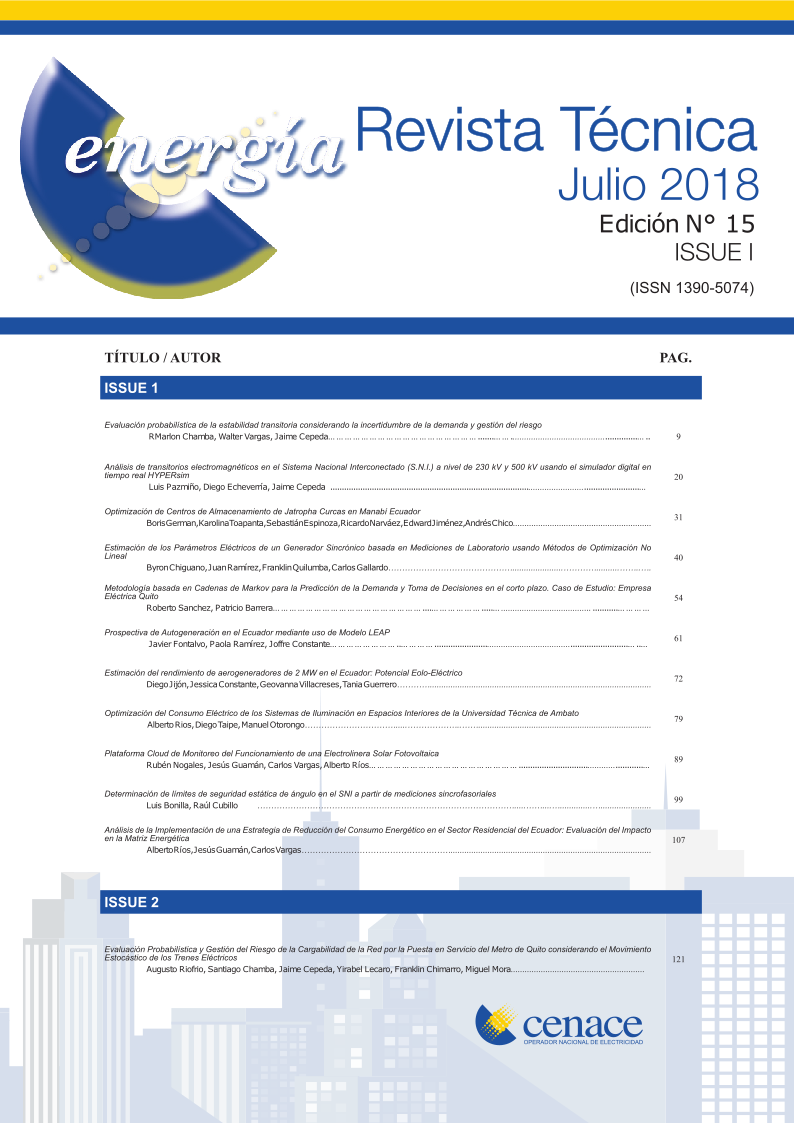
Metodología basada en Cadenas de Markov para la Predicción de la Demanda y Toma de Decisiones en el corto plazo. Caso de Estudio: Empresa Eléctrica Quito

How to Cite
Download Citation



Show authors biography
Similar Articles
- Jorge Lara, Mauricio Samper, Graciela Colomé, Short-Term Prediction of Smart Metering Systems by Multivariable and Multistep Deep Learning Architectures , Revista Técnica "energía": Vol. 21 No. 1 (2024): Revista Técnica "energía", Edición No. 21, ISSUE I
- Julio Cardenas, Graciela Colomé, Estefania Tapia, Adaptive Generator Tripping to Improve Transient Stability in Systems with Renewable Generation Integration , Revista Técnica "energía": Vol. 22 No. 2 (2026): Revista Técnica "energía", Edición No. 22 ISSUE II
- Jorge Leon, Graciela Colomé, Estefanía Tapia, Identification of Critical Generators in Transient Stability Problems , Revista Técnica "energía": Vol. 21 No. 2 (2025): Revista Técnica "energía", Edición No. 21, ISSUE II
- Carlos Lozada, David Panchi, Wilson Sánchez, Andrés Jacho, Linear Regression for the Identification of the Maximum Power Point in Hybrid Microgrids Implemented in HYPERSIM , Revista Técnica "energía": Vol. 20 No. 2 (2024): Revista Técnica "energía", Edición No. 20, ISSUE II
- Wilson Brito, Wilson Sánchez, Performance Evaluation of LSTM and XGBoost Models for Electric Demand Forecasting in the Ecuadorian Power System , Revista Técnica "energía": Vol. 22 No. 2 (2026): Revista Técnica "energía", Edición No. 22 ISSUE II
- Gabriel Guañuna, Graciela Colomé, Estefanía Tapia, Short-Term Stability State Prediction in Power Systems with Renewable Generation Integration Using Deep Learning , Revista Técnica "energía": Vol. 22 No. 2 (2026): Revista Técnica "energía", Edición No. 22 ISSUE II
- José Castro, Paúl Soto, Ruth Reategui, Tuesman Castillo, Partitioning of an Electrical Distribution Systems Using K-Means and DBSCAN Clustering Algorithms , Revista Técnica "energía": Vol. 20 No. 1 (2023): Revista Técnica "energía", Edición No. 20, ISSUE I
- Alex Mullo, José Reinoso, Marlon Chamba, Carlos Lozada, Analysis and Characterization of Power Quality using Data Mining , Revista Técnica "energía": Vol. 22 No. 1 (2025): Revista Técnica "energía", Edición No. 22, ISSUE I
- Gabriel Guañuna, Santiago Chamba, Nelson Granda, Jaime Cepeda, Diego Echeverría, Walter Vargas, Voltage Stability Margin Estimation Using Machine Learning Tools , Revista Técnica "energía": Vol. 20 No. 1 (2023): Revista Técnica "energía", Edición No. 20, ISSUE I
- Julio Lascano, Luis Chiza, Roberth Saraguro, Carlos Quinatoa, Jessy Tapia, Demand Estimation for an Electric Vehicles Charging Station Through the Application of Probabilistic Methods , Revista Técnica "energía": Vol. 20 No. 1 (2023): Revista Técnica "energía", Edición No. 20, ISSUE I
You may also start an advanced similarity search for this article.
Most read articles by the same author(s)
- Paulina Vásquez, Michelle Nieto, Roberto Sánchez, Jaime Cepeda, Methodological proposal for knowledge network exploration in a graph database of CENACE’s Knowledge Management System , Revista Técnica "energía": Vol. 17 No. 2 (2021): Revista Técnica "energía", Edición No. 17, ISSUE II
- José Enríquez , Carlos Del Hierro, Roberto Sánchez, David Panchi, Integration of a Monitoring System of Climatic Conditions to the National Energy Management System , Revista Técnica "energía": Vol. 17 No. 2 (2021): Revista Técnica "energía", Edición No. 17, ISSUE II





This investigation is focused on the prediction of the electrical demand in short time. For this purpose, the “demand profiles” and the real time signal of the electrical demand of the Empresa Eléctrica Quito S.A. are used in order to determine which profile is expected to happen during the day. In this sense, this study uses the Hidden Markov Model for forecasting the electrical demand in short time. This approach first applies a learning/training process using data from the Sistema de Información Validada Operativa (SIVO). Later, a discovery process of demand profiles is performed in order to determine the most expected profile to happen during the day. This approach establishes an “expected demand area” that shall be a reference for the definitive behavior of the electrical demand.
This methodology was applied over the EEQ system and evaluated during 30 days. The final tool successes 86% of the cases and the actual value of the electrical demand in real time is inside of the band of the expected demand area.
The purpose of this work is to build an application that assist operators of the National Interconnected System, NIS, to make the decisions in short time, optimizing the resources for generation.
Article visits 2616 | PDF visits 600
Downloads
Biannual: Publications in January and July

Ebsco

Google Académico

Scielo

Doaj

Oaji

Latindex

Researchbib

Miar

DOI

Crossref

Europub

I2or

Redib