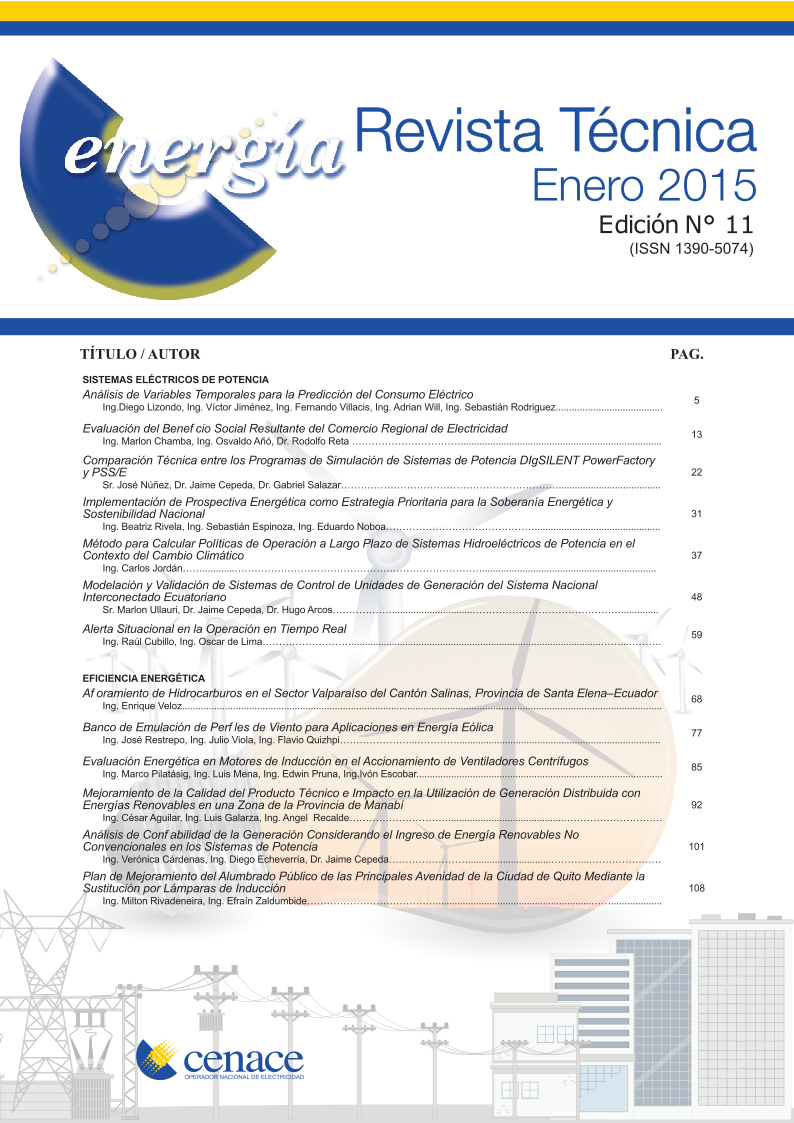
Método para Calcular Políticas de Operación a Largo Plazo de Sistemas Hidroeléctricos de Potencia en el Contexto del Cambio Climático
Método para Calcular Políticas de Operación a Largo Plazo de Sistemas Hidroeléctricos de Potencia en el Contexto del Cambio Climático

How to Cite
Download Citation

Show authors biography
Similar Articles
- Josue Ortiz, Jefferson Tayupanda, Carlos Quinatoa, Solution to the short-term hydrothermal dispatch problem through nonlinear programming applied to single and multi-node systems , Revista Técnica "energía": Vol. 20 No. 2 (2024): Revista Técnica "energía", Edición No. 20, ISSUE II
- Wilson Brito, Santiago Chamba, Diego Echeverría, Aharon De La Torre, David Panchi, Parameter Identification, Validation and Tunning of Speed Regulator Tool Using Heuristic Optimization Algorithms , Revista Técnica "energía": Vol. 20 No. 2 (2024): Revista Técnica "energía", Edición No. 20, ISSUE II
- Andrés Pereira, Roberth Saraguro, Carlos Quinatoa, Evaluation of Active Power Losses in the Electrical System of the Empresa Eléctrica Quito (EEQ) Applying an Optimization Algorithm , Revista Técnica "energía": Vol. 21 No. 1 (2024): Revista Técnica "energía", Edición No. 21, ISSUE I
- Diego Lojano, Juan Palacios, Optimal Power Flow in Electrical Power Systems with Environmental Considerations , Revista Técnica "energía": Vol. 21 No. 2 (2025): Revista Técnica "energía", Edición No. 21, ISSUE II
- Carlos Lozada, David Panchi, Wilson Sánchez, Andrés Jacho, Linear Regression for the Identification of the Maximum Power Point in Hybrid Microgrids Implemented in HYPERSIM , Revista Técnica "energía": Vol. 20 No. 2 (2024): Revista Técnica "energía", Edición No. 20, ISSUE II
- Wilson Sánchez, Diego Echeverría, Santiago Chamba, Andrés Jacho, Carlos Lozada, Economic Energy Dispatch of the Micro-Grid in the Galapagos Islands Using the Simsee Platform , Revista Técnica "energía": Vol. 21 No. 1 (2024): Revista Técnica "energía", Edición No. 21, ISSUE I
- Julio Lascano, Luis Chiza, Roberth Saraguro, Carlos Quinatoa, Jessy Tapia, Demand Estimation for an Electric Vehicles Charging Station Through the Application of Probabilistic Methods , Revista Técnica "energía": Vol. 20 No. 1 (2023): Revista Técnica "energía", Edición No. 20, ISSUE I
- Rolando Noroña, Edgar Cajas, Carlos Lozada, Marlon Chamba, Transient Stability Analysis Using the Concept of Inertia and Data Mining , Revista Técnica "energía": Vol. 22 No. 1 (2025): Revista Técnica "energía", Edición No. 22, ISSUE I
- Luis Cruz, Cristian Gallardo, Optimization of Solar Capture Using a Dual-Axis Tracker Based on an Astronomical Algorithm in a Small-Scale Photovoltaic Station , Revista Técnica "energía": Vol. 22 No. 1 (2025): Revista Técnica "energía", Edición No. 22, ISSUE I
- Jorge Leon, Graciela Colomé, Estefanía Tapia, Identification of Critical Generators in Transient Stability Problems , Revista Técnica "energía": Vol. 21 No. 2 (2025): Revista Técnica "energía", Edición No. 21, ISSUE II
You may also start an advanced similarity search for this article.






The purpose of this paper is to present an optimization method to calculate robust quasioptimal operating policies of hydrothermal power systems (SHTP). An optimal policy means one of lowest cost, and robust one that despite variations in the inflow to the reservoir produces a number of failures less than or equal to 10%. As a case study, the method was applied to a SHTP with hydroelectric features similar to Paute. This procedure is a variation of the method of particles, and consists of two phases: first, an optimal policy is calculated that corresponds to the average inflow to the plant reservoir, and second, in its neighborhood another one is looked for that is also robust. In both phases searches are performed using genetic algorithms. In order to consider the effects of climate change horizons of 30 years were used. This method could be useful to estimate quasi-optimal robust policies on the longterm operation of hydroelectric plants. It could also be used to estimate properly the size of its reservoirs in the planning stages. Initially, when the method was applied to the case under study no robust quasi-optimal policies were found; this was no surprise since its hydroelectric plant had characteristics that corresponds to an “in passing” central. However, when the size of the reservoir was increased, then various solutions with the desired characteristics were found. It is the system administrator who will ultimately decide which one to apply.
Article visits 436 | PDF visits 144
Downloads
Biannual: Publications in January and July

Ebsco

Google Académico

Scielo

Doaj

Oaji

Latindex

Researchbib

Miar

DOI

Crossref

Europub

I2or

Redib