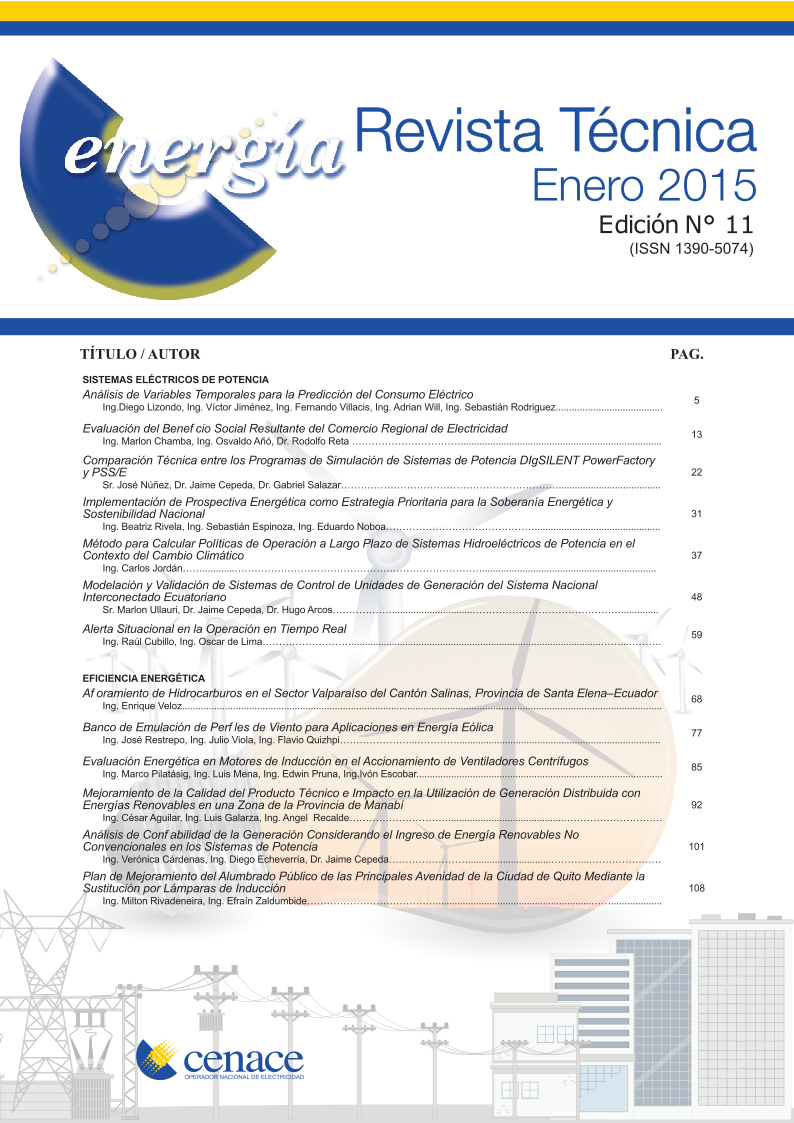
Análisis de Confiabilidad de la Generación Considerando el Ingreso de Energías Renovables No Convencionales en los Sistemas de Potencia
Análisis de Confiabilidad de la Generación Considerando el Ingreso de Energías Renovables No Convencionales en los Sistemas de Potencia

How to Cite
Download Citation



Show authors biography
Similar Articles
- Paulo Castro, Jaime Cepeda, Impact Analysis of Non-Dispatchable Renewable Energies Penetration in Power System Operational Security , Revista Técnica "energía": Vol. 22 No. 1 (2025): Revista Técnica "energía", Edición No. 22, ISSUE I
- Julio Lascano, Luis Chiza, Roberth Saraguro, Carlos Quinatoa, Jessy Tapia, Demand Estimation for an Electric Vehicles Charging Station Through the Application of Probabilistic Methods , Revista Técnica "energía": Vol. 20 No. 1 (2023): Revista Técnica "energía", Edición No. 20, ISSUE I
- José Castro, Paúl Soto, Ruth Reategui, Tuesman Castillo, Partitioning of an Electrical Distribution Systems Using K-Means and DBSCAN Clustering Algorithms , Revista Técnica "energía": Vol. 20 No. 1 (2023): Revista Técnica "energía", Edición No. 20, ISSUE I
- Gabriel Guañuna, Santiago Chamba, Nelson Granda, Jaime Cepeda, Diego Echeverría, Walter Vargas, Voltage Stability Margin Estimation Using Machine Learning Tools , Revista Técnica "energía": Vol. 20 No. 1 (2023): Revista Técnica "energía", Edición No. 20, ISSUE I
- Carlos Lozada, David Panchi, Wilson Sánchez, Andrés Jacho, Linear Regression for the Identification of the Maximum Power Point in Hybrid Microgrids Implemented in HYPERSIM , Revista Técnica "energía": Vol. 20 No. 2 (2024): Revista Técnica "energía", Edición No. 20, ISSUE II
- Jorge Leon, Graciela Colomé, Estefanía Tapia, Identification of Critical Generators in Transient Stability Problems , Revista Técnica "energía": Vol. 21 No. 2 (2025): Revista Técnica "energía", Edición No. 21, ISSUE II
- Luis Chiza , Jaime Cepeda, Transmission Corridor Stability Margin Prediction Applying Data Mining Criteria and Machine Learning Algorithms , Revista Técnica "energía": Vol. 18 No. 1 (2021): Revista Técnica "energía", Edición No. 18, ISSUE I
- Joffre Constante, Lesly Ochoa, Brayan Caiza, Walter Rueda, Omar Chuquitarco, Parametric Identification of the Oscillatory Component Load Model Using Synchrophasor Measurements and Optimization Techniques , Revista Técnica "energía": Vol. 22 No. 2 (2026): Revista Técnica "energía", Edición No. 22 ISSUE II
- Joffre Constante, Robert Quinga, Klever Tigasi, Mauricio Mullo, Estimation of Exponential Recovery Load Model Parameters Using Synchrophasor Measurements , Revista Técnica "energía": Vol. 22 No. 2 (2026): Revista Técnica "energía", Edición No. 22 ISSUE II
- Wilson Sánchez, Diego Echeverría, Santiago Chamba, Andrés Jacho, Carlos Lozada, Economic Energy Dispatch of the Micro-Grid in the Galapagos Islands Using the Simsee Platform , Revista Técnica "energía": Vol. 21 No. 1 (2024): Revista Técnica "energía", Edición No. 21, ISSUE I
You may also start an advanced similarity search for this article.
Most read articles by the same author(s)
- J. Núñez, J. Cepeda, G. Salazar, Comparación Técnica entre los Programas de Simulación de Sistemas de Potencia DIgSILENT PowerFactory y PSS/E , Revista Técnica "energía": Vol. 11 No. 1 (2015): Revista Técnica "energía", Edición No. 11
- W. Almeida , J. Cepeda , V. Flores , Modelación Estática y Dinámica del AGC en PowerFactory Integrado a la Base de Datos del Sistema Eléctrico Ecuatoriano , Revista Técnica "energía": Vol. 12 No. 1 (2016): Revista Técnica "energía", Edición No. 12
- V. Cárdenas , D. Echeverría , J. Cepeda , Determinación de los Modelos Estocásticos de Generación de las Centrales del Sistema Nacional Interconectado , Revista Técnica "energía": Vol. 12 No. 1 (2016): Revista Técnica "energía", Edición No. 12
- D. Echeverría, P. Salazar, J. Cepeda, H. Arcos, Implementación del Método SIME (Single Machine Equivalent) en DIgSILENT PowerFactory para calcular Márgenes de Estabilidad Transitoria , Revista Técnica "energía": Vol. 12 No. 1 (2016): Revista Técnica "energía", Edición No. 12
- G. Argüello, J. Cepeda, D. Echeverría, S. Falcones, J. Layana, Desafíos en la Implementación de un Laboratorio de Simulación Digital en Tiempo Real de Sistemas Eléctricos de Potencia , Revista Técnica "energía": Vol. 12 No. 1 (2016): Revista Técnica "energía", Edición No. 12
- D. Echeverría , J. Cepeda, Identificación de Máquinas Críticas ante Problemas de Estabilidad Transitoria basado en Data Mining y Mediciones Sincrofasoriales , Revista Técnica "energía": Vol. 11 No. 1 (2015): Revista Técnica "energía", Edición No. 11
- C. Palacios , D. Echeverría , R. Barba , Estudio del Impacto de la Implementación del Sistema de Protección Sistémica en la Operación del Sistema Nacional Interconectado , Revista Técnica "energía": Vol. 12 No. 1 (2016): Revista Técnica "energía", Edición No. 12
- J. Báez, S. Ordóñez, J. Cepeda, P. Verdugo, F. Quilumba, Definición de Estudios Eléctricos para Determinar la Ubicación de Unidades de Medición Sincrofasorial en Sistemas Eléctricos de Potencia , Revista Técnica "energía": Vol. 13 No. 1 (2017): Revista Técnica "energía", Edición No. 13
- J. Oscullo, V. Cárdenas, Influencia sobre el Factor de Emisión de Co2 del Sistema Nacional Interconectado debido al Ingreso de la Central Coca Codo Sinclair , Revista Técnica "energía": Vol. 9 No. 1 (2013): Revista Técnica "energía", Edición No. 9
- J. Cepeda, J. Rueda, Identificación de Equivalentes Dinámicos Mediante Optimización de Mapeo Media-Varianza en Ambiente DIgSILENT Power Factory , Revista Técnica "energía": Vol. 9 No. 1 (2013): Revista Técnica "energía", Edición No. 9





This paper addresses the determination of spinning reserve of synchronous generators that has to be considered to compensate the possible fluctuations in power systems due to incorporation of generation from non-conventional renewable energy (ERNC). The interest is to develop a generation reliability study (Generation Adequacy), considering the dispatch of ERNC. Using the simulation software DIgSILENT PowerFactory, the test system IEEE New England has been modeled. In this system, conventional and non-conventional power generation plants have been considered. Afterwards, a methodology that considers the variability of wind and solar resources has been applied. This method takes into account adequate models that predict the energy fluctuations, allowing estimating the effect of the increase or decrease of such technologies on the generation of hydraulic and thermal units, as well as on the reliability of the system. The obtained results about the inclusion of non-conventional renewable energy will allow recommending appropriate levels of installed capacity of this non-conventional generation and will permit suggesting operational actions in order to ensure sufficient reserve capacity to face the fluctuations of ERNC.
Article visits 2526 | PDF visits 1290
Downloads
Biannual: Publications in January and July

Ebsco

Google Académico

Scielo

Doaj

Oaji

Latindex

Researchbib

Miar

DOI

Crossref

Europub

I2or

Redib