QV Analysis for the Identification of Vulnerable Zones to Voltage Collapse: A Study Case
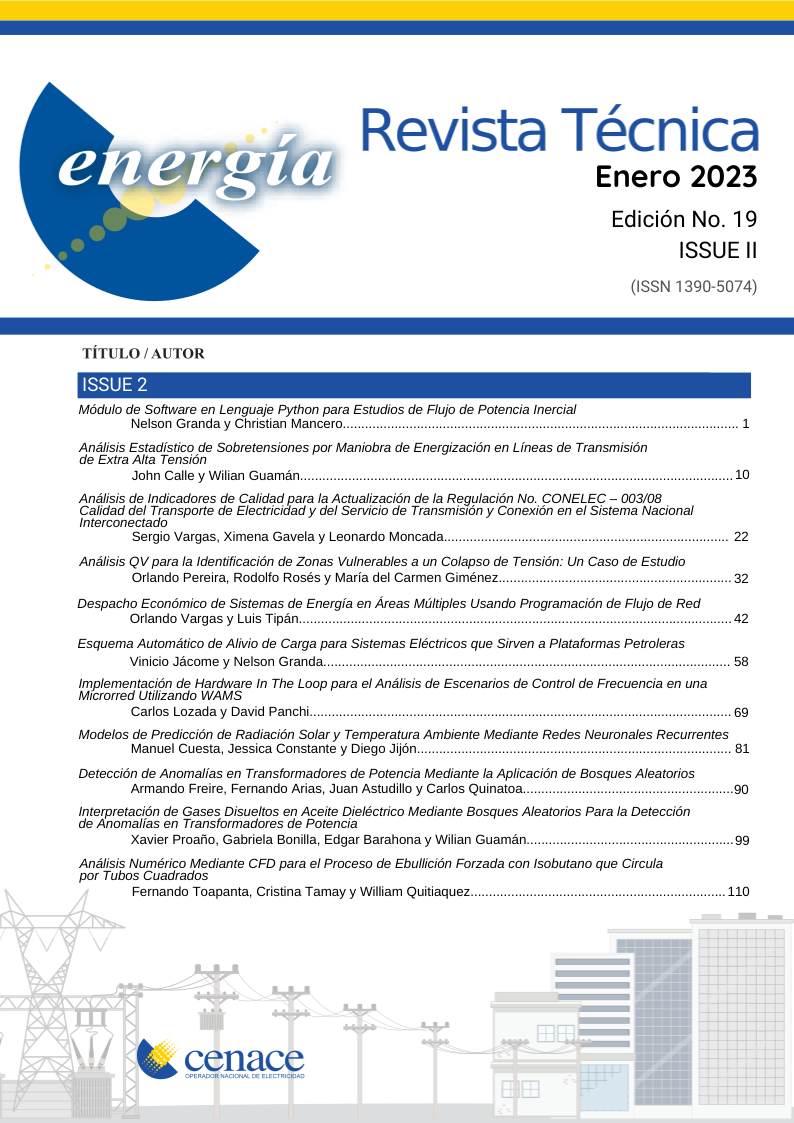
Análisis QV para la Identificación de Zonas Vulnerables a un Colapso de Tensión: Un Caso de Estudio

How to Cite
Download Citation



Show authors biography
Similar Articles
- Andrés Pereira, Roberth Saraguro, Carlos Quinatoa, Evaluation of Active Power Losses in the Electrical System of the Empresa Eléctrica Quito (EEQ) Applying an Optimization Algorithm , Revista Técnica "energía": Vol. 21 No. 1 (2024): Revista Técnica "energía", Edición No. 21, ISSUE I
- Paulo Castro, Jaime Cepeda, Impact Analysis of Non-Dispatchable Renewable Energies Penetration in Power System Operational Security , Revista Técnica "energía": Vol. 22 No. 1 (2025): Revista Técnica "energía", Edición No. 22, ISSUE I
- Diego Lojano, Juan Palacios, Optimal Power Flow in Electrical Power Systems with Environmental Considerations , Revista Técnica "energía": Vol. 21 No. 2 (2025): Revista Técnica "energía", Edición No. 21, ISSUE II
- Rolando Noroña, Edgar Cajas, Carlos Lozada, Marlon Chamba, Transient Stability Analysis Using the Concept of Inertia and Data Mining , Revista Técnica "energía": Vol. 22 No. 1 (2025): Revista Técnica "energía", Edición No. 22, ISSUE I
- HOLGUER VINICIO YUGLA LEMA, Tuning of the Parameters of a D-Statcom for Voltage Stability with Presence of Distributed Generation , Revista Técnica "energía": Vol. 21 No. 2 (2025): Revista Técnica "energía", Edición No. 21, ISSUE II
- Sasha Palacios, Ecuadorian National Interconnected System (SNI) Using the Equal Area Criterion and Synchrophasor Measurements , Revista Técnica "energía": Vol. 22 No. 1 (2025): Revista Técnica "energía", Edición No. 22, ISSUE I
- Carlos Lozada, David Panchi, Wilson Sánchez, Andrés Jacho, Linear Regression for the Identification of the Maximum Power Point in Hybrid Microgrids Implemented in HYPERSIM , Revista Técnica "energía": Vol. 20 No. 2 (2024): Revista Técnica "energía", Edición No. 20, ISSUE II
- Julio Lascano, Luis Chiza, Roberth Saraguro, Carlos Quinatoa, Jessy Tapia, Demand Estimation for an Electric Vehicles Charging Station Through the Application of Probabilistic Methods , Revista Técnica "energía": Vol. 20 No. 1 (2023): Revista Técnica "energía", Edición No. 20, ISSUE I
- Jorge Leon, Graciela Colomé, Estefanía Tapia, Identification of Critical Generators in Transient Stability Problems , Revista Técnica "energía": Vol. 21 No. 2 (2025): Revista Técnica "energía", Edición No. 21, ISSUE II
- Jorge Lara, Mauricio Samper, Graciela Colomé, Short-Term Prediction of Smart Metering Systems by Multivariable and Multistep Deep Learning Architectures , Revista Técnica "energía": Vol. 21 No. 1 (2024): Revista Técnica "energía", Edición No. 21, ISSUE I
You may also start an advanced similarity search for this article.
Most read articles by the same author(s)
- Rodolfo Rosés, Dario Carestía, Guillermo Gizzi, Implementation of EMS Applications in a Subtransmission System , Revista Técnica "energía": Vol. 16 No. 2 (2020): Revista Técnica "energía", Edición No. 16





Radial High-Voltage networks have problems ensuring voltage stability when a fault occurs. Among preventive actions for these events, installing reactive power compensation in the most vulnerable zones to voltage instability is an economical and simple alternative. Previous works have used the QV curves methodology based on contingency power flows to identify such zones. However, this method has been criticized because it does not consider the dynamical effect of some network elements that depend on the voltage levels, especially in contingency scenarios. This article proposes a QV curve analysis based on the operating point resulting from dynamic simulations to amend this critique. To evaluate the proposed procedure, the model of the Patagonian High-Voltage Network in southern Argentina is used through the PSS/E software with the help of the Python programming language. The results detect the most vulnerable areas to voltage instability after a fault occurs and the reactive power necessary to maintain voltage levels in an acceptable operating range. The proposed methodology can be applied to other networks. For example, it can be used in the Latin-American context to assess future network expansions, especially on those linking countries, such as Ecuador with Perú or Colombia, or even the Centro American Interconnected System.
Article visits 1077 | PDF visits 383
Downloads
- R. Kyomugisha, C. M. Muriithi, and M. Edimu, “Voltage stability enhancement of the Uganda power system network,” in 2021 IEEE PES/IAS PowerAfrica, PowerAfrica 2021, 2021, pp. 1–5.
- S. Opana, J. K. Charles, and A. Nabaala, “STATCOM Application for Grid Dynamic Voltage Regulation: A Kenyan Case Study,” 2020 IEEE PES/IAS PowerAfrica, PowerAfrica 2020, 2020.
- P. Chawla and B. Singh, “Voltage Stability Assessment and Enhancement Using STATCOM - A Case Study,” Eng. Technol. Int. J. Electr. Comput. Eng., vol. 7, no. 12, p. 148, 2013.
- CIGRE, CIGRE Green Books: Flexible AC Transmission Systems: FACTS, 1st ed. Springer International Publishing, 2020.
- J. Park, S. Yeo, and J. Choi, “Development of ± 400Mvar World Largest MMC STATCOM,” in 2018 21st International Conference on Electrical Machines and Systems (ICEMS), 2018, pp. 2060–2063.
- B. Gao, G. K. Morison, and P. Kundur, “Voltage Stability Evaluation using Modal Analysis,” IEEE Power Eng. Rev., vol. 12, no. 11, p. 41, 1992.
- F. Ruiz-Tipan, C. Barrera-Singana, and A. Valenzuela, “Reactive power compensation using power flow sensitivity analysis and QV curves,” in 2020 IEEE ANDESCON, ANDESCON 2020, 2020.
- T. Van Cutsem and C. Vournas, Voltage stability of electric power systems. 2008.
- C. W. Taylor, N. J. Balu, and D. Maratukulam, Power System Voltage Stability. McGraw-Hill, 1994.
- X. Liang, H. Chai, and J. Ravishankar, “Analytical Methods of Voltage Stability in Renewable Dominated Power Systems: A Review,” Electricity, vol. 3, no. 1, pp. 75–107, 2022.
- B. H. Chowdhury and C. W. Taylor, “Voltage stability analysis: V-Q power flow simulation versus dynamic simulation,” IEEE Trans. Power Syst., vol. 15, no. 4, pp. 1354–1359, 2000.
- A. Rijesh and S. Chakraborty, “Performance analysis of smart device : STATCOM for grid application,” in 2017 IEEE Region 10 Symposium (TENSYMP), 2017, pp. 1–5.
- N. Manjul and M. S. Rawat, “PV/QV Curve based Optimal Placement of Static Var System in Power Network using DigSilent Power Factory,” in 2018 IEEE 8th Power India International Conference (PIICON), 2018.
- R. Kumar, A. Mittal, N. Sharma, I. V. Duggal, and A. Kumar, “PV and QV Curve Analysis Using Series and Shunt Compensation,” in 2020 IEEE 9th Power India International Conference (PIICON), 2020.
- M. Khaled and A. O. A. Elsayed, “Voltage Profile Enhancement in Middle District of Sudan Electric Grid Using Neplan Software,” in 2019 International Conference on Computer, Control, Electrical, and Electronics Engineering (ICCCEEE), 2019, pp. 1–6.
- J. E. Sarmiento et al., “Finding unstable operating points via one-dimensional manifolds,” 2019 IEEE Milan PowerTech, PowerTech 2019, 2019.
- V. N. Sewdien, R. Preece, J. L. R. Torres, and M. A. M. M. Van Der Meijden, “Evaluation of PV and QV based voltage stability analyses in converter dominated power systems,” Asia-Pacific Power Energy Eng. Conf. APPEEC, vol. 2018-Octob, pp. 161–165, 2018.
- T. Van Cutsem et al., “IEEE PES Task Force on Test Systems for Voltage Stability Analysis and Security Assessment Technical Report,” 2015.
- Y. Lou, Z. Ou, Z. Tong, W. Tang, Z. Li, and K. Yang, “Static Volatge Stability Evaluation on the Urban Power System by Continuation Power Flow,” in 2022 5th International Conference on Energy, Electrical and Power Engineering (CEEPE), 2022, pp. 833–838.
- TRANSENER S.A, “Guía de Referencia del Sistema de Transporte de Energía Eléctrica en Alta Tensión 2022-2029,” 2021.
Biannual: Publications in January and July

Ebsco

Google Académico

Scielo

Doaj

Oaji

Latindex

Researchbib

Miar

DOI

Crossref

Europub

I2or

Redib