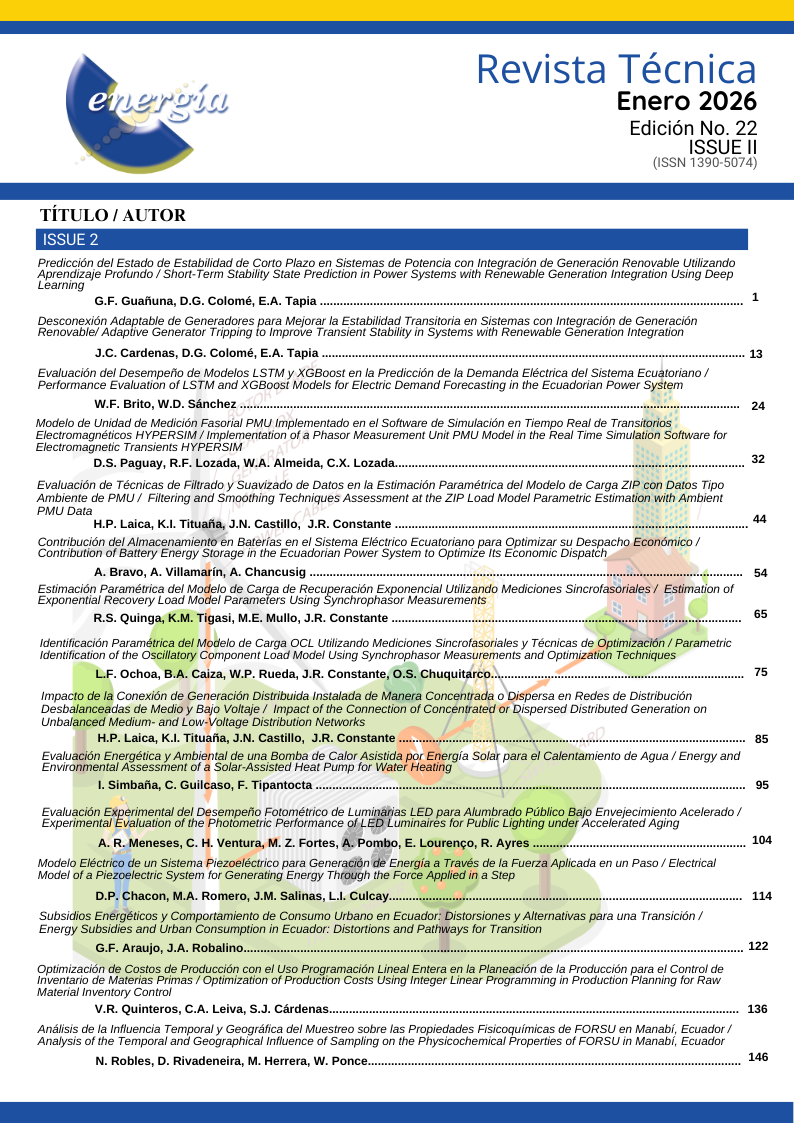
Optimization of Production Costs Using Integer Linear Programming in Production Planning for Raw Material Inventory Control
Optimización de Costos de Producción con el Uso Programación Lineal Entera en la Planeación de la Producción para el Control de Inventario de Materias Primas

How to Cite
Download Citation



Show authors biography
Similar Articles
- Diego Lojano, Juan Palacios, Optimal Power Flow in Electrical Power Systems with Environmental Considerations , Revista Técnica "energía": Vol. 21 No. 2 (2025): Revista Técnica "energía", Edición No. 21, ISSUE II
- Wilson Sánchez, Diego Echeverría, Santiago Chamba, Andrés Jacho, Carlos Lozada, Economic Energy Dispatch of the Micro-Grid in the Galapagos Islands Using the Simsee Platform , Revista Técnica "energía": Vol. 21 No. 1 (2024): Revista Técnica "energía", Edición No. 21, ISSUE I
- Andrés Pereira, Roberth Saraguro, Carlos Quinatoa, Evaluation of Active Power Losses in the Electrical System of the Empresa Eléctrica Quito (EEQ) Applying an Optimization Algorithm , Revista Técnica "energía": Vol. 21 No. 1 (2024): Revista Técnica "energía", Edición No. 21, ISSUE I
- Josue Ortiz, Jefferson Tayupanda, Carlos Quinatoa, Solution to the short-term hydrothermal dispatch problem through nonlinear programming applied to single and multi-node systems , Revista Técnica "energía": Vol. 20 No. 2 (2024): Revista Técnica "energía", Edición No. 20, ISSUE II
- Alex Villamarín, Angie Bravo, Ariel Chancusig, Contribution of Battery Energy Storage in the Ecuadorian Power System to Optimize Its Economic Dispatch , Revista Técnica "energía": Vol. 22 No. 2 (2026): Revista Técnica "energía", Edición No. 22 ISSUE II
- Alex Villamarín Jácome, Miguel Saltos, Juan Echever, Optimal Sizing of Photovoltaic and Battery Energy Systems in Residential Environments to Reduce Dependence on Centralized Electricity Infrastructure , Revista Técnica "energía": Vol. 21 No. 2 (2025): Revista Técnica "energía", Edición No. 21, ISSUE II
- Carlos Lozada, David Panchi, Wilson Sánchez, Andrés Jacho, Linear Regression for the Identification of the Maximum Power Point in Hybrid Microgrids Implemented in HYPERSIM , Revista Técnica "energía": Vol. 20 No. 2 (2024): Revista Técnica "energía", Edición No. 20, ISSUE II
- Iván Pazmiño, Anghelo Moreira , Juan Carlos Intriago, Marcos Ponce, Milton Moreano, Comparative Analysis of the Extractable Energy Potential between Fixed Photovoltaic Panels and with an Axis Tracking System Installed at the ULEAM. , Revista Técnica "energía": Vol. 20 No. 2 (2024): Revista Técnica "energía", Edición No. 20, ISSUE II
- Luis Cruz, Cristian Gallardo, Optimization of Solar Capture Using a Dual-Axis Tracker Based on an Astronomical Algorithm in a Small-Scale Photovoltaic Station , Revista Técnica "energía": Vol. 22 No. 1 (2025): Revista Técnica "energía", Edición No. 22, ISSUE I
- Paulo Castro, Jaime Cepeda, Impact Analysis of Non-Dispatchable Renewable Energies Penetration in Power System Operational Security , Revista Técnica "energía": Vol. 22 No. 1 (2025): Revista Técnica "energía", Edición No. 22, ISSUE I
You may also start an advanced similarity search for this article.
Most read articles by the same author(s)
- Kleber Zhañay, Cristian Leiva, Erika Pilataxi, William Quitiaquez, Wear - Sediment Quantity Correlation Model for Preventive Maintenance Scheduling of a Hydroelectric Power Plant , Revista Técnica "energía": Vol. 21 No. 2 (2025): Revista Técnica "energía", Edición No. 21, ISSUE II





This study proposes a cost reduction methodology for the manufacturing processes of sanitary faucet bodies, based on a mixed-integer linear programming (MILP) model designed to optimize production planning while maintaining inventory control within defined limits. The model integrates economic, logistical, and environmental restrictions such as import quotas, production capacity, and the reuse of brass scrap derived from machining operations. Using the R programming language and the lpSolve package, the optimal combination of raw materials—virgin brass ingots, rods, and recycled scrap—was determined for each product batch. The model minimizes production costs subject to constraints on material availability and storage levels. Results demonstrated a cumulative saving of USD 73,341 over six consecutive months and a reduction of average foundry inventory from 116 t to 62 t, confirming the model’s efficiency in ensuring sustainable production. The methodology is scalable to other manufacturing contexts where materials have multiple processing routes or restricted supply conditions.
Article visits 693 | PDF visits 244
Downloads
- [1] S. S. Chauhan and P. Kotecha, “An efficient multi-unit production planning strategy based on continuous variables,” Applied Soft Computing Journal, vol. 68, pp. 458–477, 2018, doi: 10.1016/j.asoc.2018.03.012.
- [2] G. Bayá, P. Sartor, F. Robledo, E. Canale, and S. Nesmachnow, A Case Study of Smart Industry in Uruguay: Grain Production Facility Optimization, vol. 1555 CCIS. 2022. doi: 10.1007/978-3-030-96753-6_8.
- [3] J. I. P. Rave and G. P. J. Álvarez, “Application of mixed-integer linear programming in a car seat assembling process,” Pesquisa Operacional, vol. 31, no. 3, pp. 593–610, 2011, doi: 10.1590/S0101-74382011000300011.
- [4] F. Dianawati and H. Fatoni, “Determining the optimal inventory holding time using mixed integer linear programming (MILP) in a forwarder company,” in AIP Conference Proceedings, 2024. doi: 10.1063/5.0242084.
- [5] J. M. Izar Landeta, C. B. Ynzunza Cortés, and O. Guarneros García, “Variabilidad de la demanda del tiempo de entrega, existencias de seguridad y costo del inventario,” Contaduria y Administracion, vol. 61, no. 3, pp. 499–513, Jul. 2016, doi: 10.1016/j.cya.2015.11.008.
- [6] A. Gholipoor, M. M. Paydar, and A. S. Safaei, “A faucet closed-loop sup-ply chain network design considering used faucet exchange plan,” J Clean Prod, vol. 235, pp. 503–518, Oct. 2019, doi: 10.1016/j.jclepro.2019.06.346.
- [7] J. Johansson, L. Ivarsson, J. E. Ståhl, V. Bushlya, and F. Schultheiss, “Hot Forging Operations of Brass Chips for Material Reclamation after Ma-chining Operations,” in Procedia Manufacturing, Elsevier B.V., 2017, pp. 584–592. doi: 10.1016/j.promfg.2017.07.152.
- [8] V. Agrawal, R. P. Mohanty, S. Agarwal, J. K. Dixit, and A. M. Agrawal, “Analyzing critical success factors for sustainable green supply chain management,” Environ Dev Sustain, vol. 25, no. 8, pp. 8233–8258, 2023, doi: 10.1007/s10668-022-02396-2.
- [9] A. Loibl and L. A. Tercero Espinoza, “Current challenges in copper recycling: aligning insights from material flow analysis with technological re-search developments and industry issues in Europe and North America,” Resour Conserv Recycl, vol. 169, Jun. 2021, doi: 10.1016/j.resconrec.2021.105462.
- [10] P. Asadi, M. Akbari, A. Armani, M. R. M. Aliha, M. Peyghami, and T. Sadowski, “Recycling of brass chips by sustainable friction stir extrusion,” J Clean Prod, vol. 418, no. June, p. 138132, 2023, doi: 10.1016/j.jclepro.2023.138132.
- [11] A. I. Kibzun and V. A. Rasskazova, “Linear Integer Programming Model as Mathematical Ware for an Optimal Flow Production Planning System at Operational Scheduling Stage,” Automation and Remote Control, vol. 84, no. 5, pp. 529–542, 2023, doi: 10.1134/S0005117923050065.
- [12] H. Su, N. Zhou, Q. Wu, Z. Bi, and Y. Wang, “Investigating price fluctuations in copper futures: Based on EEMD and Markov-switching VAR model,” Resources Policy, vol. 82, May 2023, doi: 10.1016/j.resourpol.2023.103518.
- [13] J. M. Izar Landeta, C. B. Ynzunza Cortés, and E. Zermeño Pérez, “Calculation of reorder point when lead time and demand are correlated,” Contaduria y Administracion, vol. 60, no. 4, pp. 864–873, Oct. 2015, doi: 10.1016/j.cya.2015.07.003.
- [14] Patrão, R. L., & Napoleone, A. (2024). Decision Making under Uncertainty for Reconfigurable Manufacturing Systems: A framework for uncertainty representation. IFAC-PapersOnLine, 58(19), 103–108. https://doi.org/10.1016/j.ifacol.2024.09.102
- [15] Napoleone, A., Andersen, A.-L., Brunoe, T. D., & Nielsen, K. (2023). Towards human-centric reconfigurable manufacturing systems: Literature review of reconfigurability enablers for reduced reconfiguration effort and classification frameworks. Journal of Manufacturing Systems, 67, 23–34. https://doi.org/10.1016/j.jmsy.2022.12.014
- [16] Barrera-Diaz, C. A., Nourmohammadi, A., Smedberg, H., Aslam, T., & Ng, A. H. C. (2023). An Enhanced Simulation-Based Multi-Objective Optimization Approach with Knowledge Discovery for Reconfigurable Manufacturing Systems. Mathematics, 11(6). https://doi.org/10.3390/math11061527
- [17] Ang, C. W., Yahaya, S. H., Salleh, M. S., & Cahyadi, N. (2025). A Comprehensive Review of Different Approaches used by Manufacturing Industries in Handling Capacity Planning under Demand Uncertainties. Journal of Advanced Research in Applied Sciences and Engineering Technology, 50(1), 88–106. https://doi.org/10.37934/araset.50.1.88106
- [18] Moghaddam, S. K., Houshmand, M., Saitou, K., & Fatahi Valilai, O. (2020). Configuration design of scalable reconfigurable manufacturing systems for part family. International Journal of Production Research, 58(10), 2974–2996. https://doi.org/10.1080/00207543.2019.1620365
- [19] Imseitif, J., & Nezamoddini, N. (2020). Macro and micro-production planning for reconfigurable manufacturing systems. Proceedings of the 2020 IISE Annual Conference, 784–789.
- [20] Gainanov, D. N., Berenov, D. A., Nikolaev, E. A., & Rasskazova, V. A. (2022). Integer Linear Programming in Solving an Optimization Problem at the Mixing Department of the Metallurgical Production. In Lecture Notes in Computer Science (including subseries Lecture Notes in Artificial Intelligence and Lecture Notes in Bioinformatics): Vol. 13621 LNCS. https://doi.org/10.1007/978-3-031-24866-5_12
- [21] Rasskazova, V. A. (2024). LIP Model in Solving RCPSP at the Flow Type Production. In Communications in Computer and Information Science: Vol. 1913 CCIS. https://doi.org/10.1007/978-3-031-48751-4_6
- [22] Angizeh, F., Montero, H., Vedpathak, A., & Parvania, M. (2020). Optimal production scheduling for smart manufacturers with application to food production planning. Computers and Electrical Engineering, 84. https://doi.org/10.1016/j.compeleceng.2020.106609
- [23] Coronado-Hernandez, J. R., de la Hoz, L., Leyva, J., Ramos, M., & Zapatero, O. (2020). Linear programming model to minimize the production costs of an adhesive tape company | Modelo programación lineal para minimizar los costos de producción de una empresa de cintas adhesivas. Proceedings of the LACCEI International Multi-Conference for Engineering, Education and Technology. https://doi.org/10.18687/LACCEI2020.1.1.369
- [24] Vanli, A. S., & Karas, M. H. (2025). Material and Process Modification to Improve Manufacturability of Low-Lead Copper Alloys by Low-Pressure Die Casting Method. Metals, 15(2). https://doi.org/10.3390/met15020205
- [25] Ying, K.-C., Lin, S.-W., Pourhejazy, P., & Lee, F.-H. (2025). Production scheduling of additively manufactured metal parts. CIRP Journal of Manufacturing Science and Technology, 57, 100–115. https://doi.org/10.1016/j.cirpj.2025.01.005
- [26] Yang, Z., & Liu, S. (2025). Fairness-oriented multi-objective optimization of supply chain planning under uncertainties. Socio-Economic Planning Sciences, 99. https://doi.org/10.1016/j.seps.2025.102198
Biannual: Publications in January and July

Ebsco

Google Académico

Scielo

Doaj

Oaji

Latindex

Researchbib

Miar

DOI

Crossref

Europub

I2or

Redib